YCH Group leverages AI to boost customs efficiency and cargo safety at Vietnam SuperPort™
4 Jul 20253 min read

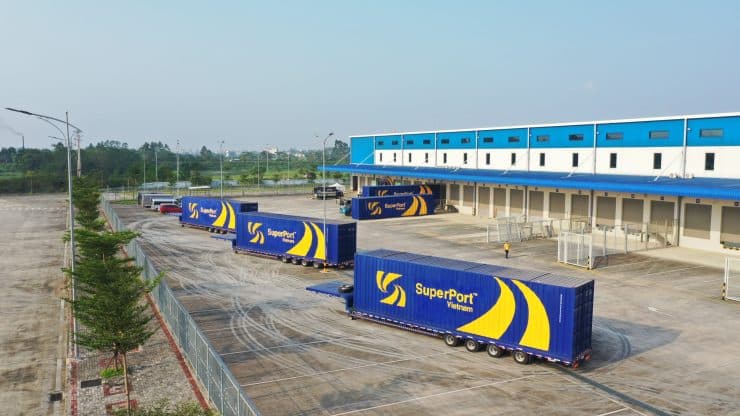
Summary
- YCH Group has integrated AI into customs clearance at its Vietnam SuperPort™, driving a projected 35 % uplift in productivity through document validation and intelligent X-ray screening.
- The AI tools flag anomalies in real time — such as misdeclared or dangerous goods — but maintain a “human-in-the-loop” model: flagged cargo is routed for manual inspection by trained staff.
- Rather than replacing jobs, AI is empowering YCH’s workforce by offloading repetitive work and allowing staff to focus on more judgment-based tasks, improving decision-making speed and accuracy.
YCH Group, Asia’s leading integrated supply chain provider, has announced the successful integration of advanced AI technologies into customs clearance operations at its Vietnam SuperPort™, projecting a 35% increase in productivity and enhanced cargo compliance capabilities.
The application of AI-driven tools like document validation and intelligent X-ray screening aims to simplify the customs process, reduce turnaround times, and minimize human error. The goal is to enable real-time alerting and anomaly detection to improve both efficiency and cargo security.
Employees were involved from the outset in defining operational challenges and testing solutions. According to Vietnam Superport™ CEO, Dr. Yap Kwong Weng, “our operations teams were involved early in the development phase, helping to define challenges and test the tools.” YCH’s training approach emphasizes hands-on learning with real-life use cases, equipping staff to utilize AI tools effectively while retaining a human-in-the-loop oversight model.
“
“Staff at Vietnam SuperPort™ will be trained to work with these AI tools built into their daily work flow,” said Dr. Yap Kwong Weng.
Contrary to concerns that automation might reduce workforce needs, Dr. Yap Kwong Weng affirms that AI enables teams to shift focus from repetitive tasks to more strategic and judgment-based roles. “Feedback from staff has been positive, as they recognize that AI reduces repetitive tasks, saves time, and enhances decision making.”
Moreover, they note that the pivot towards AI is part of empowering their teams. “While automation enables us to manage higher volumes with greater speed and accuracy, the focus is on empowering our teams by shifting their roles from manual, repetitive tasks to higher-value, judgement-based work,” Dr. Yap Kwong Weng notes.
For customers, the AI rollout translates to faster, more accurate customs processing. While AI systems won’t independently contact shippers or consignees, they provide frontline staff with clearer insights and faster flagging of documentation discrepancies, allowing for quicker resolution when follow-ups are necessary.
“
“If customer follow-up is needed, it will still be done by our team, now equipped with better context and faster response times,” Dr. Yap Kwong Weng assures.
One of the most pressing concerns is the difficulty of AI models to recognize context. For example, in the misdeclaration of dangerous goods in airfreight. YCH addressed this by building customized AI models trained specifically on aviation safety protocols, including regulations and historical inspection data. These models are designed to interpret context by cross-checking documentation and identifying inconsistencies that may suggest undeclared or mislabeled hazardous materials.
The AI-powered X-ray screening system was trained using annotated images of prohibited goods, allowing it to detect threats even when documentation lacks clarity. Crucially, any flagged cargo is routed for manual review by trained inspectors, ensuring compliance with the highest safety standards.
“
“Importantly, these AI systems support, not replace, human inspectors. When anomalies are detected, the AI flags the cargo for further review by trained personnel, combining machine speed with human judgement," says Dr. Yap Kwong Weng. “This layered approach ensures that AI systems are not only fast and scalable but also context-sensitive.”