Shipping rates triple and port queues lengthen as Asia carriers reroute around Africa
20 Apr 20265 min read

Summary
- Maersk, CMA CGM and Hapag-Lloyd have suspended Hormuz and Suez transits and are routing Asia-Europeservices via the Cape of Good Hope, according to The Loadstar, adding 25 to 30 days to end-to-end transit times on a lane that normally runs 30 to 35 days.
- Spot rates on affected Asia trade lanes have risen three to four times against late-2025 levels, and Maritime Executive reports that carriers have imposed emergency bunker surcharges even on services that do not touch the Middle East.
- Congestion is building at Singapore and Nhava Sheva as diverted vessels arrive out of their berthing windows, while a two-tier processing trial at Shanghai and Hong Kong is adding 24 to 48 hours of queue time for shippers still filing paperwork manually.
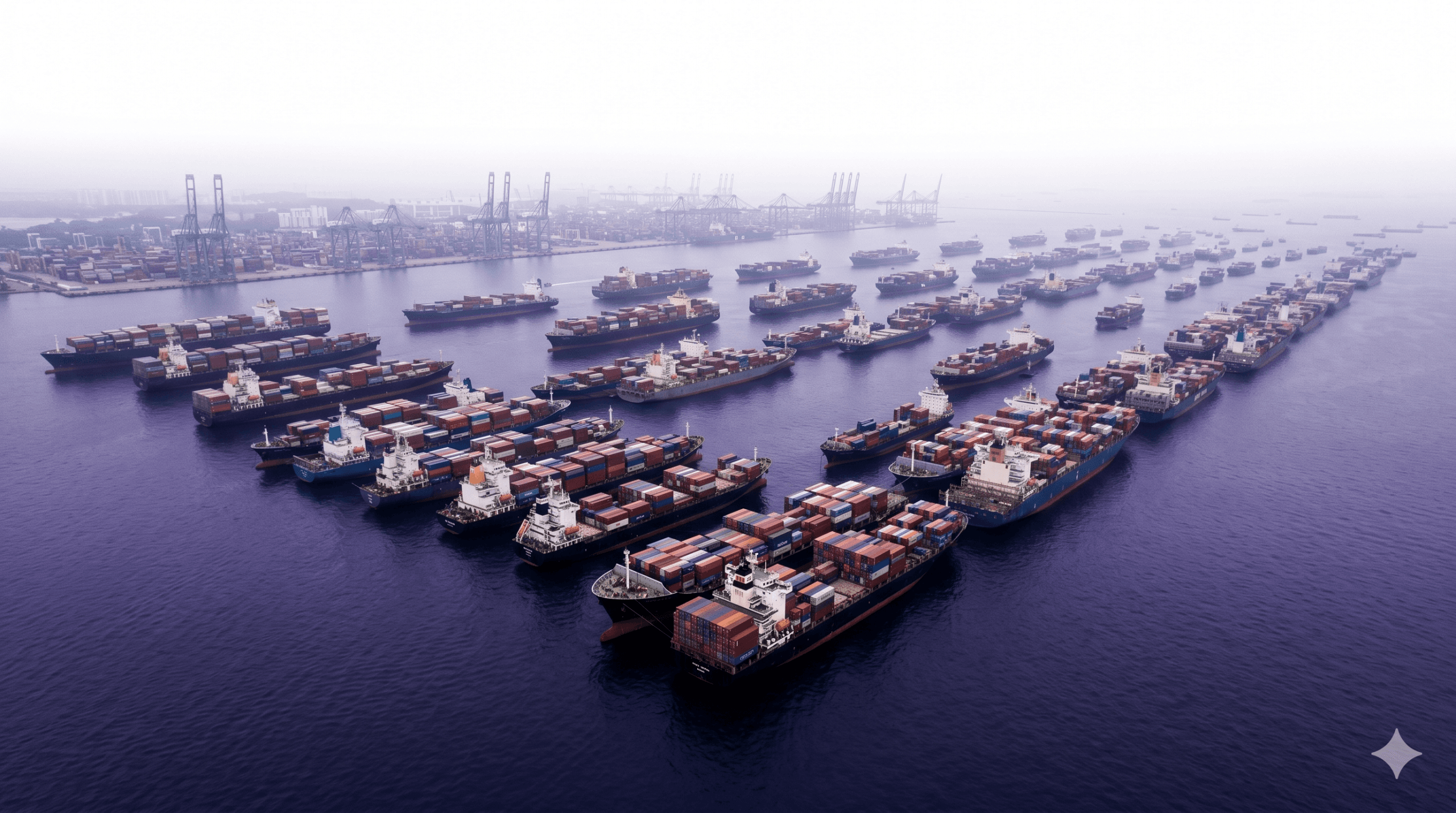
Ocean freight out of Asia has entered its most disrupted week of the year. Carriers have pulled vessels off the Red Sea and Hormuz corridors, rates on key lanes have tripled, and port yards from Singapore to Nhava Sheva are backing up as diverted ships arrive out of window.
The rerouting and the rate shock
The Loadstar reports that Maersk, CMA CGM and Hapag-Lloyd have suspended Hormuz and Suez transits and are running Asia-Europe loops around the Cape of Good Hope. Baird Maritime confirms the detour adds 25 to 30 days to a lane that normally runs 30 to 35 days port-to-port. For shippers, a single container can spend close to two months at sea instead of one.
The rate response has been immediate. Maritime Executive puts spot rates at three to four times late-2025 levels on affected trades, while The National reports carriers are imposing war-risk and emergency conflict surcharges on cargo to and from the Gulf. The surcharges extend to Trans-Pacific services that do not touch the Middle East, citing redeployed tonnage and bunker exposure. CNBC’s commodities coverage notes that exporters out of south China are receiving rate quotes with 72-hour validity windows, down from the usual fortnight.
Port congestion and a digital filter at the terminals
Port congestion is the second-order effect. Singapore is absorbing cascading schedule slippage as vessels arrive off their berthing windows, and Nhava Sheva near Mumbai is reporting yard density above working levels. Both are transhipment nodes, which means the delays propagate to feeder services across the Bay of Bengal and the Malacca Strait rather than staying local.
Separately, Shanghai and Hong Kong cargo terminals have begun a two-tier processing trial that prioritises electronic filers and deprioritises manual paperwork, per DHL Global Forwarding’s April update. The trial is adding 24 to 48 hours of queue time for manual filers, most of whom are smaller forwarders and factory-direct shippers without integrated customs platforms. The operational message is blunt: digitise the paperwork, or wait.
Three levers shippers are pulling
The first is a selective switch to airfreight for high-value or time-critical stock keeping units (SKUs). Asia-Europe air rates have climbed alongside ocean, as shippers move pharmaceuticals, electronics components and fashion replenishment onto planes. Air remains roughly ten to twelve times more expensive than ocean per kilogram, but for a container of lithium cells due on a European assembly line in two weeks, the calculation is simple.
The second is inventory buffering. Importers are pulling forward orders and paying to hold stock in bonded warehouses at Rotterdam, Felixstowe and Piraeus rather than risk stockouts during the 25 to 30-day extension. The cost is working capital; the alternative is missed retail windows during the European summer season.
The third is routing around the choke points. Bookings have risen on the China-Europe rail corridor through Kazakhstan and Russia, despite the political complications, and interest in intermodal options via the Trans-Caspian route is growing. Rail capacity out of Xi’an and Chengdu is tight and lead times are longer than pre-2024 norms, but the service is running.
The second is inventory buffering. Importers are pulling forward orders and paying to hold stock in bonded warehouses at Rotterdam, Felixstowe and Piraeus rather than risk stockouts during the 25 to 30-day extension. The cost is working capital; the alternative is missed retail windows during the European summer season.
The third is routing around the choke points. Bookings have risen on the China-Europe rail corridor through Kazakhstan and Russia, despite the political complications, and interest in intermodal options via the Trans-Caspian route is growing. Rail capacity out of Xi’an and Chengdu is tight and lead times are longer than pre-2024 norms, but the service is running.
What to watch over the next fortnight
Carriers typically announce May general rate increases in the third week of April, and this year’s announcements will set the floor for Q2 contract negotiations. If the Cape routing holds into May, Drewry’s World Container Index and the Shanghai Containerised Freight Index will test new highs. Port authorities at the Maritime and Port Authority of Singapore and the Jawaharlal Nehru Port Authority have not issued formal congestion notices so far, but berth productivity data over the next week will tell the story.
For shippers used to treating ocean freight as a stable background cost, the week is a reminder that the cost curve can move by a multiple in a matter of days. The firms that will absorb this disruption best are the ones who chose their airfreight fallback and their bonded-warehouse footprint before they needed them.